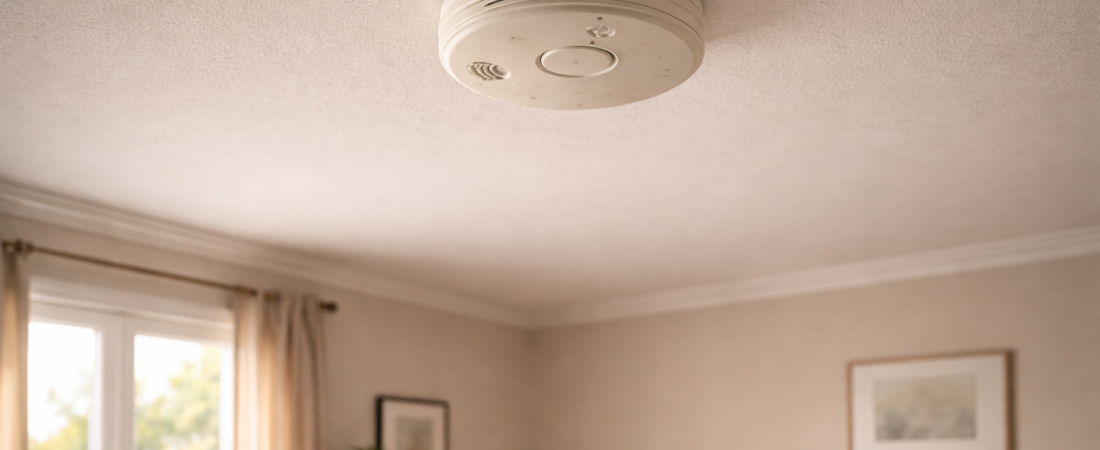
Smoke alarms are designed to operate quietly in the background.
Because they do not require daily attention, it is easy to overlook gradual ageing. Knowing the signs that indicate replacement helps keep the system dependable without waiting for complete failure.
Replacement is usually based on age and reliability, not visible damage.
The Alarm Is 8–10 Years Old
Most residential smoke alarms are designed to last around 8 to 10 years from the date of manufacture.
After this period, the internal sensing components may no longer perform consistently. Even if the alarm still sounds during testing, sensitivity can decline.
If the manufacture date shows the unit is approaching or past 10 years, replacement is generally recommended.
These age-based signals reflect the broader principle of replacement timing in the home, where service life is recognised before reliability declines.
Repeated End-of-Life Chirping
Modern smoke alarms often include an end-of-life signal.
This is usually:
A short chirp every 30–60 seconds
Continuing even after battery replacement
When chirping persists despite a new battery, it often indicates the internal system has reached its designed lifespan.
This signal means replacement, not repair.
Inconsistent Test Performance
Smoke alarms should respond immediately when the test button is pressed.
Signs of decline include:
Delayed sound
Weak or distorted alarm tone
Intermittent response
Failure to activate consistently
If testing becomes unreliable, replacement is more practical than continued troubleshooting.
Exposure to Heavy Dust or Renovation Debris
Smoke alarms are sensitive to fine particles.
Major renovations, sanding, or ceiling work can allow dust to enter the sensing chamber. Even if the alarm appears clean externally, internal contamination may affect accuracy.
If a unit has been heavily exposed and is several years old, replacement may restore confidence in its operation.
Yellowing, Brittleness, or Physical Ageing
Over time, plastic housings may:
Yellow
Become brittle
Develop minor surface cracking
While cosmetic ageing does not automatically mean failure, visible deterioration combined with age suggests the device may be near the end of its service range.
Hardwired Units Reaching the Same Age Together
In many homes, smoke alarms are installed at the same time.
If one unit reaches 10 years, the others are likely close to the same point. Replacing them together keeps the system age consistent and simplifies tracking.
When the Manufacture Date Is Unclear
If the back of the alarm does not clearly show a manufacture date, or the date is unreadable, replacement is usually the simplest decision.
Smoke alarms are relatively low-cost compared to the uncertainty of relying on an unknown service life.
Replacement Is Scheduled, Not Reactive
Smoke alarms rarely fail suddenly without warning.
Most provide signals of ageing through time, sound, or minor performance changes.
Recognising these signs allows replacement to occur calmly and predictably. Within the broader structure of replacement timing in the home, smoke alarms are one of the simplest systems to manage through routine lifecycle planning.
For a clearer understanding of expected service ranges, see how long smoke alarms should last.